What are honeybees and why are they important?
"If the bee disappeared off the surface of the globe, then man would only have four years of life left." Albert Einstein
Honeybees are one of the most important animals in the world (Davidson, 2006). With the species name Apis melliferia, they are known for the production and storage of honey and the construction of nests (National Geographic, 2010). More importantly for humans, they pollinate crops and food (Williams, 2008).
Pollination is a process in which plants transfer pollen. Without pollination, plants would be unable to create seeds. When bees feed on a plant's sweet nectar, they rub on the male parts of the plant and get pollen on themselves (Botanical-online, 2010). They then transfer and rub the pollen on the female part of the plant and the plant will produce seeds, often in the form of fruits, vegetables, or nuts (Botanical-online, 2010). By traveling from plant to plant, bees leave some pollen behind on a plant and pick up new pollen. This is called cross-pollination. By going through this process, plants are pollinated and create stronger plants, which create stronger and better fruits, vegetables, or nuts.
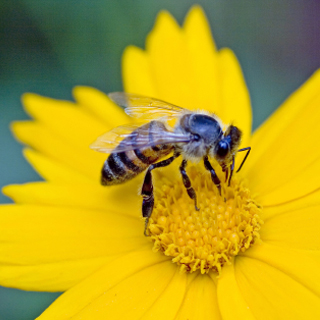
Above: Honeybee pollinating
Pollination is needed to produce crops and food. In the United States, crops are a 15 billion dollar yearly economy (Williams, 2008). Some crops depend on the pollination of honeybees so the crops will produce healthier and larger yields. About a third of the food we consume are fruits, vegetables, and nuts pollinated by bees (Williams, 2008). Without bees, we would not have these foods (Davidson, 2006).
Below: This chart shows major crops, their value, and how much pollination of the crop is dependent on honeybees.
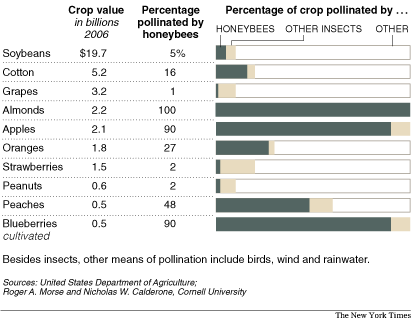
Without bees, food supplies would be reduced creating malnutrition and an economic crisis around the world (Samuelson, 2008). Products made from plants, like cotton shirts, would go up in price if bees did not pollinate (Samuelson, 2008). Einstein's quote about only living four years without bees is an exaggeration, but bees do make our lives better and easier (Williams, 2008).
Check out this video podcast about bees. It tells why bees are important and how we can help the bee population.
How do honeybees live?
Bees live in colonies or hives (National Geographic, 2010). Honeybees kept by beekeepers live in boxes with frames inside for bees to build their honeycomb. Honeycomb are hexagon shapes that are made of beeswax. These hexagons hold larvae (bees just born) and store food.
In a colony, one queen bee lays eggs, and she is the largest bee in a hive (National Geographic, 2010). A few thousand male bees, called drones, develop from unfertilized eggs and serve to fertilize the queen (National Geographic, 2010). Worker bees, the sterile females, begin life cleaning the hive and feeding the larvae and as they age, begin leaving the hive and collecting nectar and pollen (National Geographic, 2010). Honeybees are social creatures that care for one another, help one another find food, and protect one another (National Geographic, 2010). Honeybees are not native to North America but are used all over the United States to pollinate (Davidson, 2006).
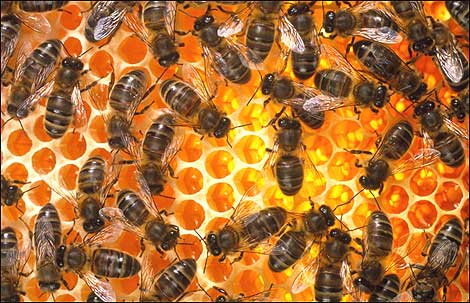
Above: Honeybees on honeycomb
What has been recently happening to bees?
Since the 1980s, bee colonies in the United States and around the world have been in decline from pathogens and pests (Kaplan, 2008). Since 2006, a rapid and extreme colony decrease started and has not stopped (Kaplan, 2008). In one winter, some bee colonies decreased by 33% (Samuelson, 2008). Scientists have called this colony collapse disorder (CCD). CCD has affected American honeybees and honeybees worldwide. 25% of honeybees have died off and 33% of hives have been left empty in the U.S. (Samuelson, 2008). Some beekeepers report 50-100% hive collapse (Williams, 2008). Scientists are questioning what is causing bees to die off so quickly and without warning. Many causes are being investigated, but no specific cause has been found. Understanding what living and nonliving things affect bees is the first step to understanding how to prevent and hopefully stop CCD.
Understanding CCD
Several patterns and symptoms seem to occur to hives suffering from CCD. The first sign of CCD is that a healthy colony of many individuals rapidly becomes a colony with few or no surviving bees (Williams, 2008). Queens are often found with a few young females, broods, and food (Williams, 2008). Even though worker bees are not at the colony, they are not found dead and seem to just disappear (Williams, 2008). The remaining bees are often infected with multiple diseases (Williams, 2008). Wax worm moths and hive beetles normally invade dead hives quickly but they are not attracted to the hives going through CCD until awhile afterward (Samuelson, 2008).
Many questions remain about CCD including exactly what it entails and how it happens. Scientists have now started regulating and tracking colonies and bees better so they can learn more about the initial signs of CCD to prevent it. Some countries have even started initiatives to study bees more closely. Many living and nonliving factors have implications on the lives of bees. Some of these are probably working together to cause CCD. A recent study looked at 61 specific factors that affect honeybees and found none of them to be the sole cause of CCD (vanEngelsdorp et al., 2009).
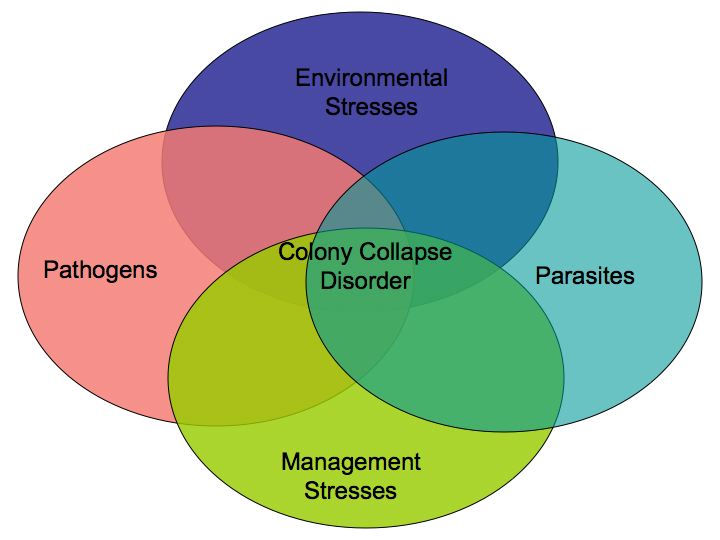
The diagram above shows that pathogens, environmental stresses, parasites, and management stresses work together in creating CCD. Within these large classifications are multiple elements that affect honeybees. The exact cause of CCD is somewhere in the middle of these elements, and scientists are trying to figure the exact spot so they can make efforts to stop CCD.
Learn how pathogens affect honeybees here.
Learn how environmental stresses affect honeybees here.
