Pesticides, drought, and genetically engineered plants are just a few of the environmental stresses that affect bees. Environmental stresses exist in the environment and affect the bees' natural food source and livelihood. Most of these stresses initially affect something else that bees need.
Pesticides
Pesticides are chemicals used to kills pests. Most of these chemicals are created to kill or control a specific type of pest but these pests are in an intricate web of nature. By affecting one thing in nature, other things are affected as well.
Pesticides began being used widely in the 1980s. They are probably a cause why bees have been declining since that time (Jacobson, 2008). Most farmers use pesticides on crops and plants to keep worms, beetles, caterpillars, and mites from eating the crop (Frazier, Mullen, Frazier, & Ashcraft, 2008). Even though these pesticides are not meant to harm honeybees, honeybees can still be affected. Because they feed on the pollen and nectar of the plant, they are eating the pesticide. Just like any chemical, it is not healthy for a bee to ingest it.
Pesticides are also used inside the hives to stop mites and diseases from spreading (Frazier, et al., 2008). Scientists are realizing more and more that although some pesticides do not outright kill the bees, pesticides do decrease bees' stamina to fight off diseases and impair bee behaviors (Frazier, et al., 2008). Different pesticides affect honeybees in different ways. Some break down the nervous system while others impair brain memory and the ability for the bee to orient itself (Williams, 2008).
One type of pesticides, neonicotinoids, seems to have the attention of scientists (Kaplan, 2008). This family of pesticides are insecticides and specifically created to kill insects (Jacobson, 2008). Neonicotinoids affect the central nervous system of an insect, cause paralysis, and death in just a few hours (Jacobson, 2008). The Environmental Protection Agency (EPA) has deemed this pesticide toxic to honeybees (Williams, 2008). Neonicotinoids are used on plants to keep the plants from being eaten by insects. But these plants need to be pollinated by honeybees, so honeybees come in contact with it. Italy, Slovenia, Germany, and France have outlawed this type of pesticide in hopes that honeybees will not be harmed by it and to control CCD (Jacobson, 2008).
Imidacloprid, a kind of neonicotinoid, has been studied in the way an early application affects bees when they come later in the season to pollinate (Jacobson, 2008). The study found that a regular dose of the chemical applied at the beginning of the season on citrus and almond trees did not dissipate during the season (Jacobson, 2008). In some test plots, imidcloprid increased over the next year to kill any insect (Jacobson, 2008). Pesticides are supposed to wear off and dissipate after awhile, but this one sometimes increases.
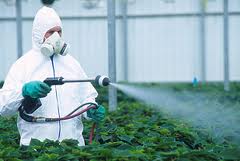
Above: Spraying pesticides on plants
Herbicides
Herbicides are chemicals used to kill specific plants. They are used in fields to kill weeds. Herbicides do not specifically harm honeybees, but the lack of certain plants may be hurtful to bees (Riedl, Johansen, Brewer, & Barbour, 2006).
Bees like a variety of sources of food. When herbicides kill off weeds and the variety of natural plants and leave just crops to be pollinated, honeybees do not like that (Williams, 2008). Just as humans need a wide assortment of foods and nutrients to be healthy, bees need an assortment of plant pollens and nectar to be healthy (Williams, 2008). By using herbicides, farmers are not killing the bees but limiting the range of food for bees (Riedl, et al., 2006).
Genetically Modified Organism (GMO) and Genetically Modified Crops (GMC)
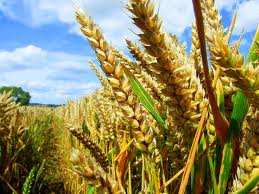
Above: Wheat is one of the only crops that is not genetically modified
Since the 1970s, different crops have been genetically altered to offer more resistance to drought and pests (Williams, 2008). Technology allows a DNA strain from one species to be inserted into a DNA strain of a different species (Williams, 2008). This has allowed DNA strains from pesticides to be inserted into the DNA of corn, canola, cotton, and soybeans (Williams, 2008). Since the DNA is different, the plant is technically different (even though it looks and tastes the same to humans) (Williams, 2008). Honeybees collecting the pollen from GMO and GMC probably have no idea they are actually collecting genetically modified pollen.
Scientists have no idea how GMC affect honeybees (Williams, 2008). GMO have been in existence from the 1970s and the dying off of bees did not start until the 1980s. Only time will tell if future generations of honeybees are affected by GMO (Williams, 2008). Because of the lack of information regarding side effects, France has banned GMO (Williams, 2008).
Weather
Honeybees are used to pollinate all over the world. They have learned to adapt to their surroundings. However, some extreme changes in weather do affect honeybees (Williams, 2008). Early freezes, extreme drought, and variances in temperature all affect bees. Early freezes kill off potential food sources. The worry of extreme drought is not killing off plants but the lack of clean water sources (Williams, 2008). Honeybees do need water to survive and when droughts occur, they have difficulty finding water. Although bees do adapt, changes in temperature and climate change do affect bees and limit their ability to survive.
Environmental Stresses and CCD
Pesticides could be a contributing factor to CCD. Scientists are still trying to figure out if neonicotineoids are causing CCD, but it does not correlate with CCD (Kaplan, 2008). Even though several European countries have outlawed this pesticide, Europe has suffered its worst losses of CCD after the ban (Jacobson, 2008). A new neonicotinoid is introduced to the market about once a week (Jacobson, 2008). With so many different types of neonicotinoids and pesticides, scientists are having a difficult time distinguishing CCD and a specific pesticide (Jacobson, 2008).
Although herbicides affect bees, scientists are not looking at them as the cause to CCD. Since they just inhibit the food source of bees and food has been found in hives with CCD, it does not seem like a cause (Riedl, 2006).
GMO have been around for decades. They are probably not the cause of CCD, but they are a concern. Since scientists do not know the long-term effects of GMO, they have no idea how future generations through genetic adaptations will be affected (Williams, 2008). No one highly used GMO has been in use all over the world which puts a doubt of GMO affecting bees enough to cause CCD, which is so widespread.
Although some scientists do believe the earth is going through climate change, this is not seen as a cause of CCD. Honeybees have adapted for thousands of years so even though some may be affected, they should not all be dying off because of it (Jacobson, 2008).
Although environmental stresses affect honeybees, they do not seem to be a cause of CCD. They may hurt colonies and honeybee populations, but honeybees seem to be adapting to most environmental stresses.
