Parasites are relatives of ticks. They are tiny pests that can infect one bee, breed, and kill off an entire colony (Davidson, 2006). Two main types of mites affect bee colonies (Davidson, 2006).
Varroa destructor
This mite first appeared in Asia in 1904 and has since moved across the world, except Australia (which has not suffered widespread CCD) (CNN Tech, 2007). It is a flat, eight-legged mite (Davidson, 2006). It jumps onto the outside of worker bees and hides in a fold of skin (Davidson, 2006). Since it is wedge-shaped, it can slide itself into the soft skin of the bee under the bee's tough outer layer (Davidson, 2006). When it is at the soft skin, it bites the bee with its mouth, which is a set of tiny hooks (Davidson, 2006).
Asian honeybees seem to be more sensitive to this mite and have figured out ways to rid themselves of it (Davidson, 2006). When a worker bee is bit, she immediately starts dancing around and tries to knock it off her (Davidson, 2006). When in the hive, other bees notice this and groom the bee (Davidson, 2006).
European honeybees have not had so much luck with this parasite (Davidson, 2006). They do not seem to notice the mite on them and will be bit (Davidson, 2006). Bit bees have shorter life spans and often suffer from pathogens because of a weakened immune system (Davidson, 2006).
Miticides, chemicals used to kill mites, have been shown to be effective in killing the varroa mite (Davidson, 2006). But since its use, the life of the queen bee has decreased by half (Davidson, 2006). Without the miticides, the hive would not be alive at all though (Davidson, 2006).
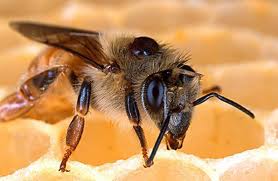 | At left: Bee with varroa mite on back |
Acarapis woodi
This mite is small and infects the tracheal system of the bee (Davidson, 2006). Since bees are insects, they do not have lungs or blood that carries oxygen. Instead bees move air through their bodies which contain sets of pipes call trachea (Davidson, 2006). This mite infests and breeds in these pipes (Davidson, 2006). Each invading mite lays eggs and these mites rapidly hatch and lay more eggs (Davidson, 2006). They feed on the wall of the trachea (Davidson, 2006). Bees infected with this mite seem paralyzed (Davidson, 2006). They can be seen crawling around the hive and soon after, the entire colony dies (Davidson, 2006).
To right: Microscopic picture of Acarapis woodi | 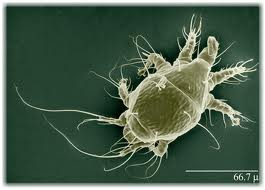 |
Parasites and CCD
Parasites could be a contributing factor to CCD. These two parasites were found in North American by the 1980s and are part of the cause of declining bee populations in the '80s (Davidson, 2006). However, these parasites had been in North America for years before CCD in 2006. Scientists do look at parasites as a potential contributing factor to CCD. Since parasites weaken bees, they could be the first step in allowing another factor to affect bees.
