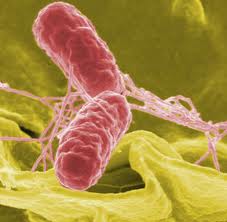
Above: Microscopic view of a pathogen
Pathogens are more commonly known as germs, viruses or fungi. They are microscopic, which means they cannot be seen with the naked eye. They often bring disease to their host. In this case, pathogens infect honeybees with different diseases. As early as 700 BC, European beekeepers have noticed their hives suffer from diseases (Davidson, 2006). Aristotle in 330 BC wrote about diseases his honeybees had and attributed the diseases to bad pollen and nectar (Davidson, 2006). Scientists now know that diseases are not caused by bad nectar or pollen but by tiny germs that can spread to infect an entire hive. Scientists have found more than thirty diseases caused by pathogens that affect honeybees (Davidson, 2006).
IAPV
IAPV stands for Israeli acute paralysis virus. It was first discovered in 2004 in Israel by researchers at Hebrew University. IAPV is a virus that is known to infect insects and kill them (Watanabe, 2008). It has been found in hives with CCD.
Scientists are trying to figure out how IAPV came into existence and how it has spread all over the Northern hemisphere. Three different strands of the disease have been found in Australia, Israel, and the Eastern United States (Watanabe, 2008). The Australian strand of the disease is also found in California and other Western states (Watanabe, 2008). This is because the United States imported honeybees from Australia starting in 2005 to ease pollination concerns (Watanbe, 2008). After researching the three strands, scientists have found that Australian honeybees can become infected with IAPV but do not come down with any symptoms (CNN Tech, 2007). They do carry the disease though and hives imported to the United States from Australia do have IAPV but show no symptoms (CNN Tech, 2007).
Scientists think a small hive beetle that is a carrier of IAPV brought the disease to the United States (Watanabe, 2008). The beetle does not do much damage to hives elsewhere in the world, so scientists think it brought IAPV to the U.S. and infected the honeybees not resistant to IAPV (Watanabe, 2008).
Another possible source of IAPV is from royal jelly imported from Manchuria (Watanabe, 2008). Although the royal jelly is supposed to be only for cosmetic uses, some beekeepers use it as feed for queen bees (Watanabe, 2008). If the jelly had IAPV in it, the disease would not affect humans using it for cosmetic purposes. Queen bees ingesting it could be infected by IAPV if the jelly had IAPV in it. By ingesting the pathogen, the queen would carry the pathogen to the hive and infect other honeybees.
Honeybees suffering from IAPV develop shivering wings and paralysis (CNN Tech, 2007). Worker bees with the disease die close to the hive (CNN Tech, 2007).
Paenibacillus larvae
Paenibacillus larvae is a rod-shaped bacterium that causes American foulbrood (Davidson, 2006). First found in 1904 by Gershom Franklin White, Paenibacillus larvae has been found infecting hives throughout the world and destroying a large proportion of bee colonies (Davidson, 2006).
The American foulbrood disease has several symptoms. Healthy honeybee larvae in the honeycomb are normally white (Davidson, 2006). When Paenibacillus larvae infects a hive, the larvae turn to a dark brown until the larvae melts in the honeycomb in a decaying mass (Davidson, 2006). The larvae, once infected, only live for a few days (Davidson, 2006). The smell of the decaying larvae is similar to glue (Davidson, 2006).
This pathogen produces spores that can live and be infectious for more than thirty years (Davidson, 2006). The spores can be carried from hive to hive by beekeepers (Davidson, 2006). Less than one hundred spores of Paenibacillus larvae are required to infect and kill larvae (Davidson, 2006). Some larvae have been found to have resistant traits to American foulbrood (Qin, Evans, Aronstein, Murray, & Weinstock, 2006).
Honeybees are able to detect American foulbrood within their hives. Honeybees will avoid the areas where larvae are infected and workers quickly remove sick larvae and clean the hive (Davidson, 2006). Because of this quick action, honeybees are sometimes able to stop the spread of this disease in their hives.
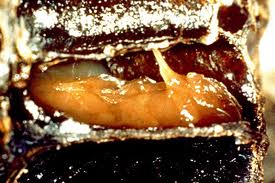
Ascosphaera Apis
Ascosphaera apis is a fungus and causes a disease called chalkbrood (Davidson, 2006). It is highly infectious and spreads quickly within a hive.
When honeybees are infected by this pathogen, the fungus grows and reproduces spores in the gut that expand into the body (Qin, et al., 2006). Dead larva and bees have a white chalky appearance due to spores growing on the outside of the honeybee (Davidson, 2006).
Dead bees with Ascpsphera apis are very infectious (Qin, et al., 2006). The disease can spread quickly within a hive. Adult bees quickly identify and remove infected bees to stop the spread of the disease (Qin, et al., 2006). Sometimes spores of the fungus infect food sources in the hive (Qin et al., 2006).
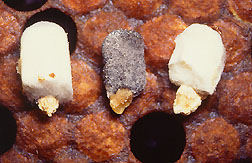
Above: Honeybees that have died after being infected with Ascosphaera apis.
Pathogens and CCD
Pathogens are at the top of scientists' radars regarding CCD. Since vaccines do not exist for honeybees, pathogens seem to be a leading cause of CCD (CNN Tech, 2007).
IAPV has been found in the United States since at least 2002 (Kaplan, 2008). Since it has been found to be in the U.S. before CCD started, scientists do not think it is the cause of CCD (Kaplan, 2008). However, IAPV has been found in 96% of hives that collapsed of CCD (CNN Tech, 2007). Since it is found in such a high percentage but not all cases of CCD, IAPV seems to be a leading culprit in CCD. But scientists are still researching it to see what other factors combine with the pathogen to cause CCD (CNN Tech, 2007). Worker bees with IAPV die close to the hive, but a sign of CCD is that dead honeybees are not found and simply disappear.
Paenibacillus larvae has been known for over one hundred years. Since it has been around and infecting hives for so long, it is probably not the cause of CCD. American foulbrood is still a threat to honeybees though because of its easy spread by both bees and beekeepers (Davidson, 2006).
Ascosphaera apis has been infecting hives for years. It is not a likely cause of CCD, but the disease is highly contagious and easily spread so it is a threat to honeybees.
Pathogens, including fungi, viruses, and bacteria, all hurt honeybees' immune systems. When a disease infects a honeybee, it is not able to work at full capacity and is capable of spreading a disease. Pathogens greatly affect the well being of honeybees and are a potential cause of CCD.
